Who Am I?

I am a Primary Science Teacher Fellow. The Teacher Fellowships are funded by the Ministry of Business, Innovation and Employment and administered by the Royal Society of New Zealand. The Fellowships are designed to support the effective teaching of science in primary and intermediate schools.
Teacher Fellows are placed in a science organisation for two terms to gain an appreciation of the Nature of Science - doing science work in a 'real life' setting. I am lucky enough to be hosted by Wellington Zoo.
To find out more about the Teacher Fellowships or see what other teachers are doing click the links in the side bar.

Wednesday, 16 October 2013

Primates

Yesterday I went on section with the primates keepers Jaqui and Nathan. Sadly there are no pictures because the weather was so lousy that I didn't want to take my camera with me.
We fed and cleaned up after the pygmy marmosets, iguanas, cotton-topped tamarins, squirrel monkeys, agouti, capuchins, spider monkeys, gibbons, chimpanzees, lemurs, and golden lion tamarins.
Two of those animals are not primates - can you tell me which ones?

I had a fantastic day as I got to hand feed many of the smaller primates - giving them small pieces of fruit to eat. We had lots of fun giving rice balls to the spider monkeys. One of the females is so nimble with her prehensile tail that she can use it to pick a rice ball out of your hand.
Find out what prehensile means. Why would this be a good adaption for a monkey to have?

It was also neat to see Jaqui using hand signals and rewards to give the chimpanzees basic health checks - seeing their hands, feet, ears and mouth. It is amazing what you can do with a little smear of peanut butter. And amazing training of course.
Here are some photos of the squirrel monkeys, cotton-tops and chimps that I took on other days.

Monday, 7 October 2013

Flying Food

On Tuesday I was up at the holiday programme that the Wellington Zoo runs. They were having a 'flight day' - looking at lots of different types of wings.
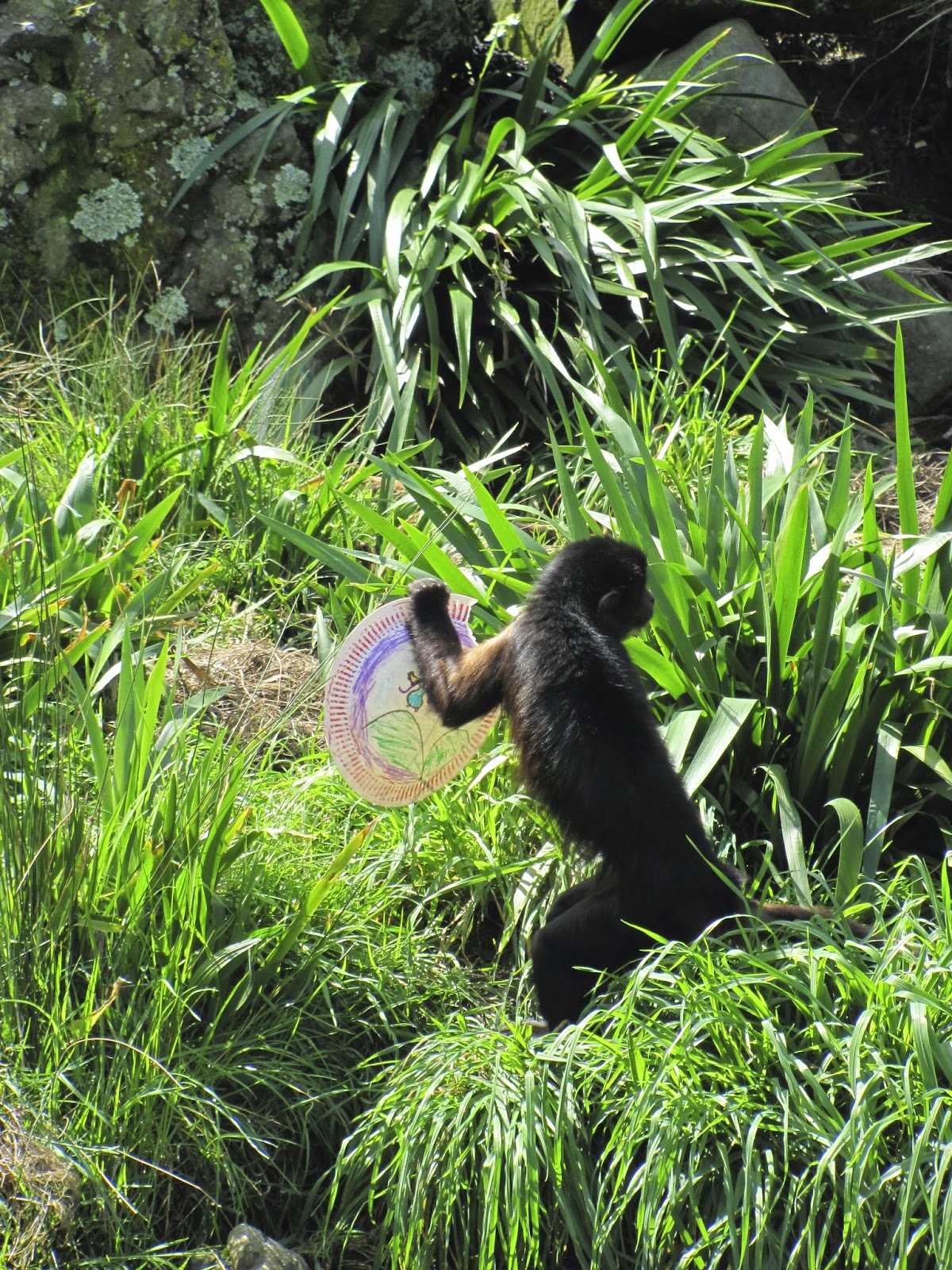
One activity they did was to decorate two paper plates then glue them together with some raisins hidden in the middle. These were then thrown like a frisbee to the capuchin and spider monkeys on 'Monkey Island'.
Some plates split apart and many others ended up in the water but the monkeys loved the ones that made it across.


Checking Penguin Boxes

Joel at Kau Bay
Last week I went out to check the boxes in Kau Bay on the northern end of the Miramar Peninsula. As it is the school holidays I took my son Joel along with me. As usual (it seems) I was on a North facing beach so the wind was blowing hard from the North!
We had to find and check the penguin nest boxes in the area but this time we had no map! We turned it into a treasure hunt. Our job was to find the boxes, check them, use the GPS to mark them and photograph their position so the next time they're checked it will be much easier.
The first box we found was number 9 so we worked back around the headland and found the ones we had missed. It was good having Joel with me as he was an excellent finder and much better at climbing under trees.
In all we found 22 boxes, but some numbers were missing and we dug up a couple of boxes that were buried in stones.
Out of all those boxes only two were occupied by Little Blue Penguins. It was a great day though and we got some useful information.
An occupied nest box - see how the flax and grass help hide the box and give the penguins cover as they are coming and going from their nest.
The Little Blue Penguin in the nest box. Can you see the egg just in front of its foot?


Thursday, 3 October 2013

Small-Clawed Otters

These guys are some of my favourite animals to watch - especially when they're in the water. They are so fast and slippery. They are Asian Small-Clawed Otters and there are two living at Wellington Zoo.
The only problem is whenever I go to see them in my uniform they run over to the keeper entrance and start 'barking'. They think they're going to be fed.
In the wild they eat crabs, molluscs, water insects and small fish, but they will also eat rodents (like mice) and snakes. Look how they hold their food while eating it.

They always grab their food and take it down to the water edge to eat - what are some reasons you can think of that they would do that?
They also always go for a swim after eating - what are some reasons they would do that?
If they are cleaning themselves, why could that be important?

Wednesday, 25 September 2013

Penguin Stocktake

On Monday I went out with some volunteers from NZ Forest and Bird to do a penguin stocktake of  part of the south coast between Moa Point and Tarakena Bay. We were looking for the penguin boxes that were already there (and whether they were being used), sites for new boxes and possible natural nest sites. We were also looking at options for planting new to create safe habitats and shelter for the little blue penguins.
Hunting for nesting boxes.
Sadly all I saw were two skinks, who were much too fast for me to get a photo of, and no penguins.

The storms from June had damaged the coastline and trees here. Can you see how the storm piled up stones and debris on the shore and killed off the trees?


If you look closely at this picture you can see new leaves on this 'dead' bush. They will recover in time and I'm sure the birds will return to this area.

Thursday, 19 September 2013

Bird Banding

Yesterday I went out bird Banding with Peter Reese. He has been doing this for 30 years so he really knows what he is doing.
The first thing he does is put some nets up in an area of bush near a food or water source. Here there is a small stream and the native trees were flowering. Can you see the net?
You can now the sun is shining on it and so can the birds, but when it is in the shade it is very hard to see. They fly into the nets and drop into 'pockets' on either side of the net.
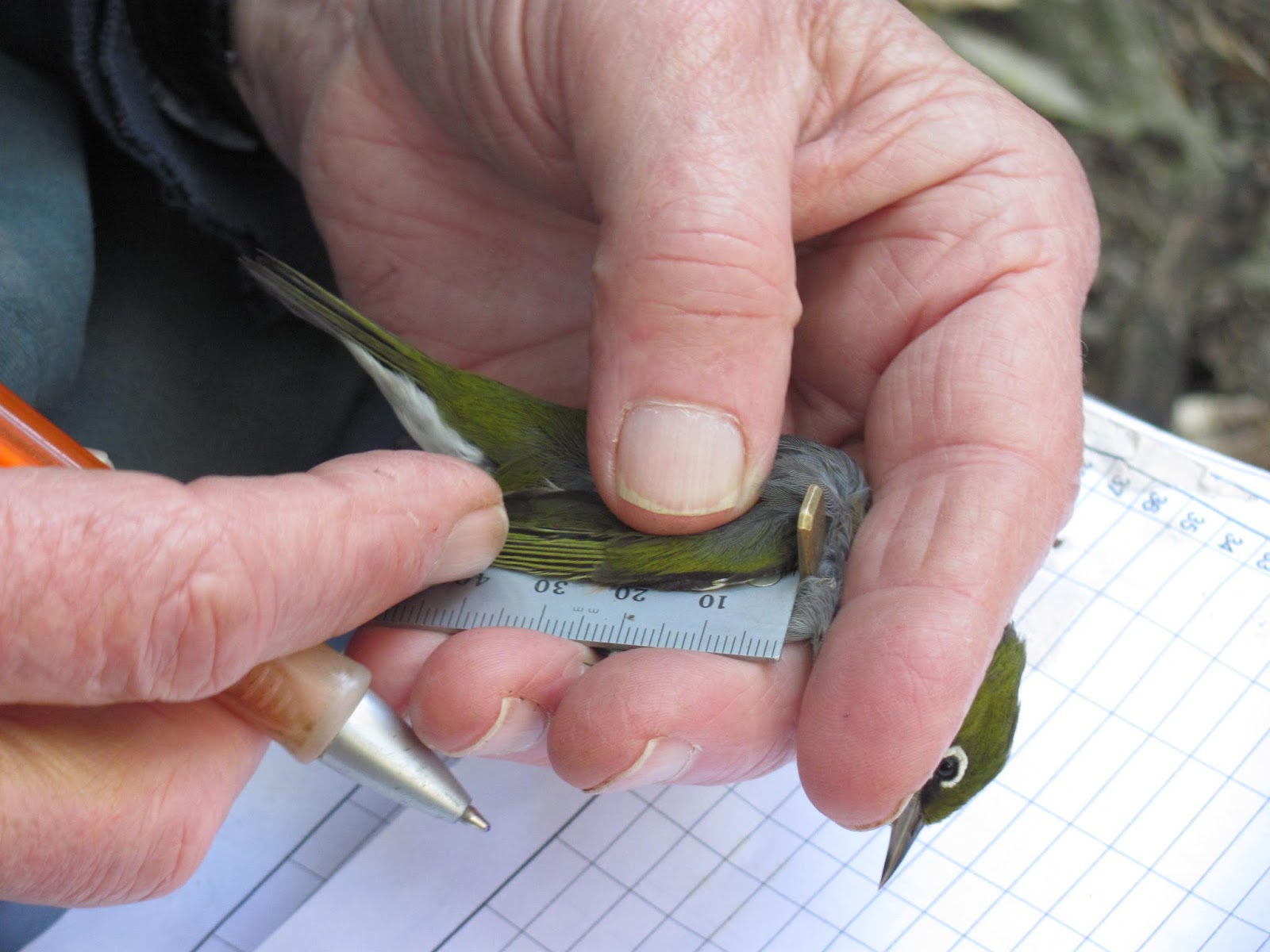
Here we have caught a Silvereye. You hold the birds gently but firmly between your fingers taking care not to hold it tightly around the chest. Then we put a band around the bird's right leg.
Then we measured its wing length.
Then we put it into a container to weigh it - it's not very dignified for the bird
 but they stay still and the are not hurt at all.
Here is a picture of me banding my first Silvereye. I also banded some other Silvereyes, Sparrows and a Chaffinch.
All the information we collect is passed on to the Department of Conservation.

Tuesday, 17 September 2013

White Cheeked Gibbons

This is Robyn and Vilson, the two white cheeked gibbons at Wellington Zoo. Robyn is the lighter coloured female, she makes the whooping noise. Vilson is the darker male, he does most of the 'singing'. Whenever Vilson stops for a rest Robyn starts whooping again - it is like they are singing a duet.
It is one of the special things about working at Wellington Zoo that you get to hear them calling every morning. You can hear them calling several kilometres away on a still morning.
Turn up the volume and have a listen.

For more information about Robyn and Vilson watch this Conservation Connection video from Wellington Zoo.