Who Am I?

I am a Primary Science Teacher Fellow. The Teacher Fellowships are funded by the Ministry of Business, Innovation and Employment and administered by the Royal Society of New Zealand. The Fellowships are designed to support the effective teaching of science in primary and intermediate schools.
Teacher Fellows are placed in a science organisation for two terms to gain an appreciation of the Nature of Science - doing science work in a 'real life' setting. I am lucky enough to be hosted by Wellington Zoo.
To find out more about the Teacher Fellowships or see what other teachers are doing click the links in the side bar.
Showing posts with label wellington zoo. Show all posts

Wednesday, 6 November 2013

Piñata for the Lions

Here is a piñata that I made for the lions. I had to make sure that there were no staples or tape left on the boxes before I started. Then for the papier mache I had to use flour and water as you can't use glue for the animals.
Why do you think we can't use glue? What different reasons might there be?
Hey what's that?
When it was all done and painted we put some meat inside it, and rubbed meat over the outside as well so it had a really nice smell for the lions.
Mine! I got it down.
CRRRunch!
The lions didn't take very long to destroy it. My poor zebra :-(

Wednesday, 16 October 2013

Primates

Yesterday I went on section with the primates keepers Jaqui and Nathan. Sadly there are no pictures because the weather was so lousy that I didn't want to take my camera with me.
We fed and cleaned up after the pygmy marmosets, iguanas, cotton-topped tamarins, squirrel monkeys, agouti, capuchins, spider monkeys, gibbons, chimpanzees, lemurs, and golden lion tamarins.
Two of those animals are not primates - can you tell me which ones?

I had a fantastic day as I got to hand feed many of the smaller primates - giving them small pieces of fruit to eat. We had lots of fun giving rice balls to the spider monkeys. One of the females is so nimble with her prehensile tail that she can use it to pick a rice ball out of your hand.
Find out what prehensile means. Why would this be a good adaption for a monkey to have?

It was also neat to see Jaqui using hand signals and rewards to give the chimpanzees basic health checks - seeing their hands, feet, ears and mouth. It is amazing what you can do with a little smear of peanut butter. And amazing training of course.
Here are some photos of the squirrel monkeys, cotton-tops and chimps that I took on other days.

Monday, 7 October 2013

Flying Food

On Tuesday I was up at the holiday programme that the Wellington Zoo runs. They were having a 'flight day' - looking at lots of different types of wings.
One activity they did was to decorate two paper plates then glue them together with some raisins hidden in the middle. These were then thrown like a frisbee to the capuchin and spider monkeys on 'Monkey Island'.
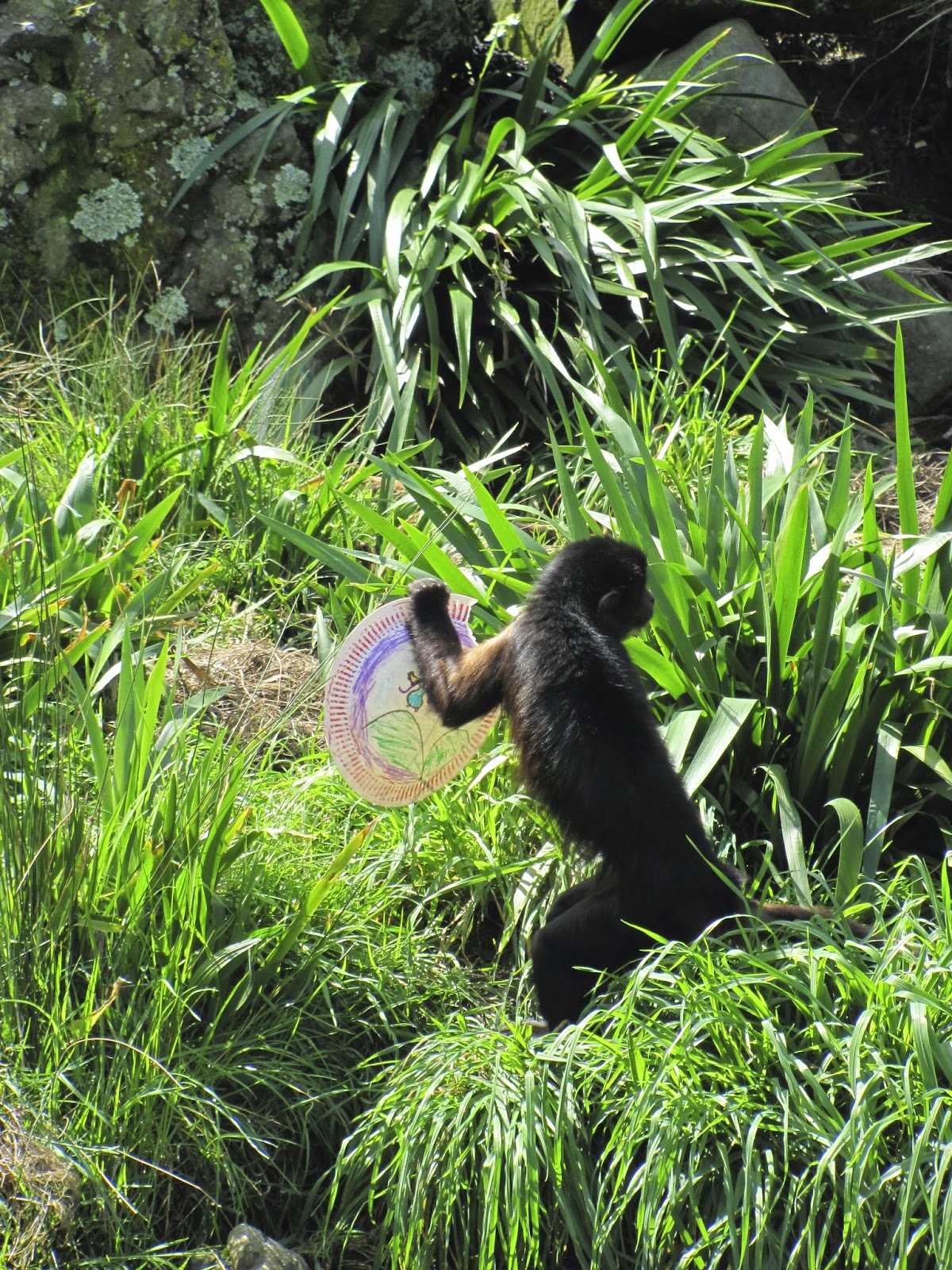
Some plates split apart and many others ended up in the water but the monkeys loved the ones that made it across.


Thursday, 3 October 2013

Small-Clawed Otters

These guys are some of my favourite animals to watch - especially when they're in the water. They are so fast and slippery. They are Asian Small-Clawed Otters and there are two living at Wellington Zoo.
The only problem is whenever I go to see them in my uniform they run over to the keeper entrance and start 'barking'. They think they're going to be fed.
In the wild they eat crabs, molluscs, water insects and small fish, but they will also eat rodents (like mice) and snakes. Look how they hold their food while eating it.

They always grab their food and take it down to the water edge to eat - what are some reasons you can think of that they would do that?
They also always go for a swim after eating - what are some reasons they would do that?
If they are cleaning themselves, why could that be important?

Sunday, 15 September 2013

Feeding Lanky

Well after writing about Lanky on Wednesday I went out on section with Phil the bird keeper. I was lucky enough to feed Lanky.
First we had to cut up his fish. We filleted (cut the meat off) five medium sized fish and then cut that into small chunks - roughly about 5cm squares. That is his two meals for the day.
I had to throw the fish into Lanky's beak. He lunges forward as he catches it - and that is a pretty big beak to lunge at you. It made me jump a bit the first time.
He has a real routine - he has about the first third of his meal standing by the fence and for the rest he is swimming in the water.
Sometimes Lanky decides he doesn't like a piece of fish and drops it on the ground. Then you have to break the fish up even smaller with you hands. Other times he pretends he wants the fish then ducks his head out of the way - naughty Lanky!

Wednesday, 11 September 2013

Lanky

This is Lanky. He is one of the oldest animals at Wellington Zoo, he is about 36 years old.
He is an Australian Pelican. Lanky is a bit fussy and will only eat his fish if it's cut up. If you are lucky visiting the zoo then you might see him being fed by the keepers - throwing bits of fish into his great big beak. A pelican that lived at Wellington Zoo before Lanky has the world record as the oldest known pelican. His name was Percy and he  lived to be 62 years old.
My questions today are about Lanky's beak. It's a pretty big beak and with that throat pouch underneath  it can hold an awful lot. 
Why would he need a beak like that? What could he carry in it? Does he carry things or is it for something else?
Look at the close up of the end of Lanky's beak. Can you see the big hook shape on the end? I wonder what that could be for?
(remember these are not a run to the internet to find the answer questions - I want you to think hard and tell your answers to someone else, have a discussion)

Sunday, 8 September 2013

Checking The Traps

As part of looking after the Little Blue Penguins on the South coast the zoo looks after some pest traps. On Thursday I went out with Lynn to check some of the traps. If you remember the weather on Thursday it wasn't pleasant - really strong winds and icy rain.
Checking a trap.
Lynn walking in to the wind.
Little Blue Penguins nest in burrows on the shore in among the bushes. What sort of animals would be their predators? Think about what will eat the birds, what will eat their eggs or their chicks.
What animals do you think we are catching with these traps?

Wednesday, 4 September 2013

Sam's New Blanket

Today some students from Epuni School came to the Wellington Zoo to start their Bushbuilders programme. They had been knitting at school and they had made a blanket to give to the chimpanzees.
Here are some of the students handing over the blanket to the keepers.
Here's what happened when Sam got the blanket - I love the way he lays it on the ground carefully before sitting on it!
Sam using his new blanket to keep warm!
Well done to the students from Epuni School.

Saturday, 17 August 2013

Chameleons

One of my favourite animals I have met at Wellington Zoo is the Chameleon. The are so fantastically strange and other-worldly. From the way they look to the way they walk.
Their eyes are just amazing.
They can shoot their tongues out longer than their bodies to catch their prey. Check out this video.
Chameleon Tongue

My questions are about Chameleon tails.
What does this shape remind you of?
They have long tails - what are they used for?
Why do you think they keep them curled like this? How could it be helpful for the Chameleon?

Introduction

I have been at the zoo for a few weeks now and have had some amazing experiences being able to get up and close with some of the animals. Here I am feeding a red panda on my first day at the zoo.
I have met many other animals which I hope to share with you along the way, ask you lots of questions about them, and share my other experiences.